Welcome
Discover Inner Peace with Spiritual Memoir
Embark on a transformative journey through silence and awakening.

A deeply personal spiritual memoir tracing one soul's journey inward — from the restless questioning of ordinary life to the profound stillness that lies at the heart of all existence.
Drawing on years of seeking, pilgrimage, and practice, Devsingh weaves together lived experience with the timeless wisdom of Vedanta and Bhakti traditions.
The narrative moves through pivotal encounters with saints, sacred spaces, and silent retreats — each chapter a threshold crossed, a veil lifted. At its core, the book is an invitation: to recognise that the Infinite is not elsewhere, but the very ground of one's own being.
A deeply personal memoir of spiritual awakening through Vedanta, Bhakti, and silence. By Devsingh. Now on Amazon.

Most professionals spend their careers developing technical skills. Few spend time on the skills that actually determine how far they go — how they think under pressure, lead others, navigate organizations, and build a career that holds meaning over the long run.
The Inward Quest is a guide to those skills.
Across four parts, the book covers the full arc of professional life — from self-knowledge and emotional resilience, to building and leading teams, navigating complex organizations, and finding purpose in the work itself.
Written to work for the first-year professional and the senior leader equally.
Note: Book is Coming Soon!
Open today | 09:00 am – 05:00 pm |
I live at the intersection of two worlds — the contemplative and the practical — and I write from both.
By day I work as a Program Manager, navigating the complexity of large-scale projects and the people who make them move. By a longer road, I am also an author — drawn to the deeper questions that professional life rarely makes time for, but never quite lets go of.
My first book, Journey to Infinity Within — Stories of Virtues and Masters, is a spiritual memoir now available on Amazon Kindle. It brings together thirty portraits of the great masters — Buddha, Ramakrishna, Vivekananda, Ramana Maharshi, Anandamayi Ma and many more — alongside thirty virtues and the shadow states that work against them. It is a companion for anyone who has felt, at some quiet moment, both tiny and infinite at the same time.
My second book, The Inward Quest — Inner Mastery, is currently in progress. .
Both books grow from the same root: the belief that knowing yourself is the beginning of everything else.
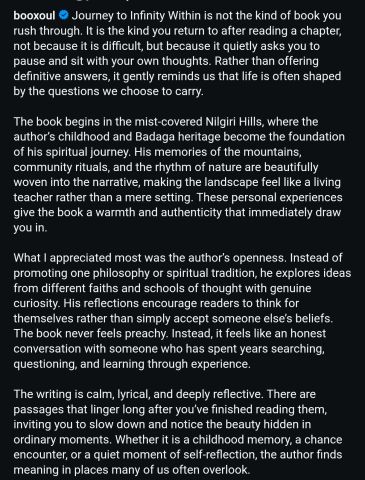
I was born and raised in the Nilgiri Hills of South India, in the Badaga community of Ooty — a landscape and a people that left a deep imprint on how I see the world.
Journey to Infinity Within is available now on Amazon Kindle.
The Inward Quest — coming soon.
If you have ever felt that ordinary life is not enough — that beneath the noise of daily existence something vast and silent waits to be discovered — this book is written for you. Journey to Infinity Within is not a text on philosophy. It is a lived account: of doubt, of seeking, of grace encountered in unexpected places, and of the recognition that the Infinite is not elsewhere — it is the very ground of your own being. Available on Amazon India and Amazon globally.
Spiritual awakening · Vedanta · Bhakti · Self-realization · Ramakrishna Mission · Silent retreat · Pilgrimage in India · Inner peace · Spiritual memoir India · Advaita Vedanta · Seeking the Infinite · Contemplative spirituality
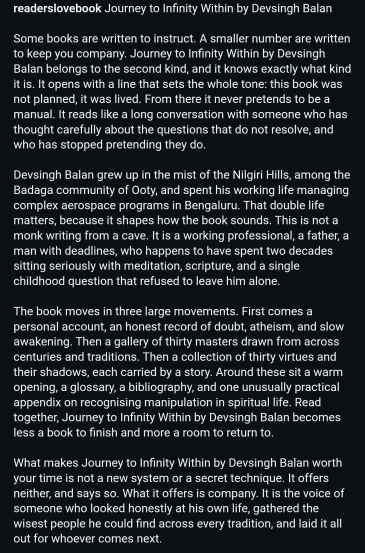
This book was not planned. It was lived.
Born in the mist-covered Nilgiri Hills to the Badaga community of Ooty, the author carried one question from childhood that refused to be silent: What is this life really for?
That question led through atheism and corporate life, through meditation halls and temples, through the Bhagavad Gita and the Ramakrishna tradition — and eventually into this book.
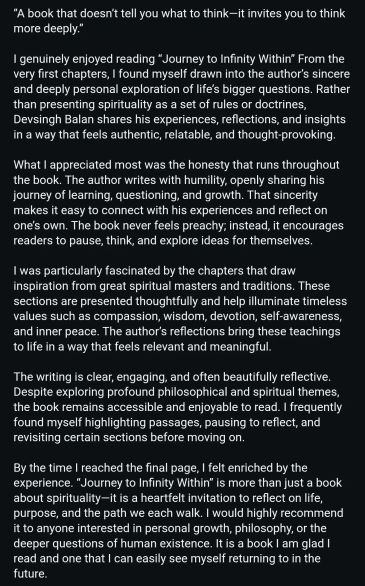
Journey to Infinity Within brings together thirty portraits of the great masters, thirty virtues and their shadows, and one honest personal story of seeking. It is not a system to follow or a technique to practice. It is a companion for anyone who has felt, at some quiet moment, both tiny and infinite at the same time.
At the level where all genuine wisdom operates, we are all the same person. Learning the same lessons. In different bodies, in different places, in different centuries.
The universe has been patient with us. It keeps teaching until we learn.
This is what one seeker learned.

Ready to get started on your journey to a more positive and successful life? Purchase the book today.
Have a question or comment about the book or the website? Get in touch via email.
The Badaga are one of the indigenous communities of the Nilgiri Hills of Tamil Nadu — farmers, dancers, and keepers of rituals older than any written text. The word Badaga means "northerner" in Kannada, reflecting the community's origins in the hills above the Deccan plateau. What distinguishes the Badaga is not doctrine but practice. Their spiritual life was not located in temples or texts but in the body, the land, and the community gathered together. The Badaga ritual dance was a community prayer made visible — performed at harvest, at planting, at celebration and at grief. Men, women, elders, and children moved together in a rhythm that dissolved the boundary between individuals and created something none of them could create alone. The Nilgiri Hills where the Badaga have lived for centuries sit at over two thousand metres above sea level. In this landscape — the shola forests, the grasslands, the mist that arrives every morning without asking permission — the sacred was never separate from the ordinary. The ordinary, experienced with full attention, became the sacred. This was the first spiritual teaching the author received — before any book, before any master, before any formal practice. The Badaga community of Ooty is the root from which Journey to Infinity Within grows.
The Indian spiritual tradition identifies four primary paths to self-realisation — each suited to a different temperament, each complete in itself: 1. Karma Yoga — The yoga of action. The path of realisation through selfless work, performing one's duties fully while releasing all attachment to results. Classically taught in the Bhagavad Gita. 2. Bhakti Yoga — The yoga of devotion. The path of realisation through love — directing the full force of the heart toward the divine. The path of Ramakrishna, Chaitanya Mahaprabhu, and Anandamayi Ma. 3. Jnana Yoga — The yoga of knowledge. The path of realisation through direct inquiry into the nature of the self and reality. The path of Ramana Maharshi and Adi Shankaracharya. 4. Raja Yoga — The royal yoga. The path of realisation through the systematic training of the mind, classically codified in Patanjali's Yoga Sutras. Additional paths covered in the book include: 5. Kriya Yoga — The specific system of energy and breath practices transmitted through the Yogananda lineage, designed to accelerate spiritual development by working directly with the body's subtle energies. 6. Kundalini Yoga — The yoga of awakened energy, practised through Vethathiri Maharishi's Simplified Kundalini Yoga system. 7. Tantra — The broad family of traditions that regard the body, the senses, and the world as sacred — working with rather than against material existence as the path to realisation.
Chapter Two of Journey to Infinity Within presents thirty portraits of the great spiritual masters — each a living demonstration of what awakening looks like in a human life: 1. Siddhartha Gautama — The Buddha 2. Mahavira 3. Sant Dnyaneshwar 4. Guru Nanak Dev Ji 5. Chaitanya Mahaprabhu 6. Sri Ramakrishna Paramahamsa 7. Swami Vivekananda 8. Sri Aurobindo 9. Paramahansa Yogananda 10. Ramana Maharshi 11. Subramania Bharathi 12. Anandamayi Ma 13. Jiddu Krishnamurti 14. Osho — Bhagwan Shree Rajneesh 15. Swami Chinmayananda 16. U.G. Krishnamurti 17. Swami Sivananda Saraswati 18. Swami Ramdas (Papa Ramdas) 19. Maharishi Mahesh Yogi 20. Thirumular 21. Vallalar — Ramalinga Swami 22. Maha Periyava — Sri Chandrasekharendra Saraswati 23. Yogi Ramsuratkumar 24. Vethathiri Maharishi 25. Neem Karoli Baba 26. Lord Krishna 27. Jesus Christ 28. Hanuman — The Servant Who Is the Master 29. Lord Shiva — The Great Auspicious One 30. Divine Mother
Chapter Three presents thirty living virtues — each explored through story, teaching, and reflection: 1. Truth & Integrity 2. Courage 3. Compassion & Kindness 4. Mercy, Benevolence & Empathy 5. Humility & Honour 6. Generosity & Self-Sacrifice 7. Wisdom & Discernment 8. Patience, Forbearance & Endurance 9. Forgiveness & Reconciliation 10. Faith, Trust & Hope 11. Service & Devotion 12. Justice, Equity & Righteousness 13. Peace, Non-Violence & Unity 14. Contentment & Non-Attachment 15. Detachment & Renunciation 16. Discipline, Austerity & Self-Control 17. Purity & Right Intention 18. Gratitude & Reverence 19. Goodness, Gentleness, Simplicity 20. Balance & Temperance 21. Perseverance & Endurance 22. Joy & Celebration 23. Loyalty & Faithfulness 24. Integrity in Leadership 25. Mindfulness & Presence 26. Love & Belonging 27. Creativity & Inspired Action 28. Inner Strength & Resilience 29. Acceptance & Surrender 30. Equanimity — The Steady Centre The Ten Shadow States (Chapter Three, Part Two): 31. Fear & Anxiety 32. Pride & Arrogance 33. Anger, Wrath & Impatience 34. Grief, Despair & Longing 35. Doubt & Hesitation 36. Envy, Jealousy, Resentment & Self-Pity 37. Shame & Guilt 38. Greed, Lust & Obsession 39. Sloth, Complacency & Apathy 40. Betrayal, Ingratitude & Suspicion
The personal narrative of Journey to Infinity Within moves through these pivotal moments: 1. The Badaga Dance — A community prayer made visible; the first spiritual teaching received before any book or master. 2. The Nilgiri Mist — The mountain as first teacher; lessons of impermanence, presence, and mystery absorbed in childhood. 3. The Out-of-Body Experience — At age six, the first intimation that reality is larger than the visible. 4. The Jyotirlinga Question — At age nine, watching the Mahabharata serial, the question that lodges like a splinter: if God created this, who created God? 5. The Crack in Inherited Faith — At seventeen, a classmate's question: "Do you believe any of that, or do you just say you do?" 6. The Phone Call That Changed Everything — A classmate calling at the right moment, saving an academic year; the first recognition of grace operating through ordinary channels. 7. The Atheist Years — The freedom and the flatness of strict materialism; the universe that could not account for its own light. 8. The Bicycle and the Door — A friend's story of a childhood wish fulfilled; curiosity re-entering the door that atheism had closed. 9. The Book That Cracked the World Open — Yogananda's Autobiography of a Yogi and the realisation that the mechanical universe is not the whole story. 10. The Journey Home — Radhanath Swami's memoir and the recognition that the longing was not weakness but the soul's impatience with a life lived below its own depth. 11. The First Grace: Bengaluru — At the Yogoda Satsanga centre, a sudden experience of vastness, joy, and boundlessness — unearned, unrepeatable, unmistakable. 12. The Second Grace: Guruvayur — In a packed, noisy temple, the same quality of experience arriving in the last place the atheist expected it. 13. The Formal Initiation — At the Ramakrishna Math, being called forward from ten rows back by the senior monk conducting the deeksha. 14. The Goddess as a Small Girl — A seven-year-old outside a Devi temple in Kannur whose look of recognition has never been forgotten. 15. The Navratri Revelation — In Coimbatore, the understanding of Krishna and Shakti as two faces of the same undivided reality. 16. The Durga Saptashati Initiation — Received alone, through mailed instructions, without a physical guru — and yet unmistakably transmitted. 17. Auroville and Thiruvannamalai — Visits to places of power; experience without full context, presence without complete preparation. 18. The Bhagavad Gita as Field Manual — The teaching on action without attachment arriving not as philosophy but as a practical tool for managing complex programs.
Chapter Three of Journey to Infinity Within draws on 69 stories from over 25 spiritual and philosophical traditions across the world. Together they form the living foundation of the book's exploration of 30 virtues and 10 shadow states.
The Indian epics and Puranas provide the largest body of stories. The Ramayana contributes eight — from Jatayu's sacrifice and Shabari's faith to Ram's equanimity and Ravana's undoing. The Mahabharata gives six, including Arjuna at Kurukshetra, Bhima and Hanuman's tail, and Karna's lifelong wound. The Bhagavata Purana adds five more — Rantideva's feast, Prahlada's resilience, Dhruva's austerity, Sudama's devotion, and the birth celebrations of Krishna.
The Bible — both Old and New Testaments contributes eleven stories, among the highest count from any single source. These range from David and Goliath, Job's endurance, and Joseph's forgiveness in the Old Testament, to the Prodigal Son, Gethsemane, Doubting Thomas, and Mary Magdalene at the empty tomb in the New.
The Buddhist canon provides seven stories — Buddha walking toward Angulimala, the wounded swan, Kisa Gotami and the mustard seed, Siddhartha leaving the palace, the insult returned as a gift, the arrow parable, and the monk and the scorpion. Three further stories come from the Chan and Zen traditions, including Bodhidharma's nine years of wall-gazing and Thich Nhat Hanh's orange.
Other traditions each contribute distinct voices. Jainism offers Mahavira's renunciation and his endurance of the nails. The Sufi tradition gives Nasruddin's boat and the flood parable. The Sikh tradition contributes Guru Nanak's honest meal. The Taoist tradition gives Zhuangzi's butterfly, the farmer's horse, and Laozi's water and the rock. Greek philosophy brings Socrates before the jury and Diogenes in the sunlight. Christian hagiography offers Francis with the wolf of Gubbio and the leper. The Marathi Varkari tradition gives Tukaram's abhangas, and the Mevlevi tradition the whirling dervishes of Rumi.
Living masters also appear as story sources — Ramana Maharshi in three accounts, Mirabai's spontaneous composition, the white cranes that took Ramakrishna into samadhi, and Michelangelo's marble as a study in inspired action.
One story — The Step That Was Always Tomorrow — is drawn from composite archetypal patterns rather than a named canonical source, depicting the quiet cost of a lifetime's postponement.
The range is deliberate. No single tradition holds a monopoly on wisdom here. The same truth — about courage, forgiveness, equanimity, or the danger of pride — arrives from a Jewish teaching story and a Tamil king's chronicle, from a Buddhist parable and a Renaissance sculptor's studio. This cross-traditional breadth is the book's central argument made visible: that at the level where genuine wisdom operates, the traditions are telling the same story in different voices, in different centuries, to the same person
The posts that follow are a preview of my second book — The Inward Quest: Inner Mastery — releasing soon.
Chapter 15 of The Inward Quest is the one I get asked about most.
It is not a chapter about technology. It is a chapter about what it means to be a professional when the easy parts of the job are no longer yours alone to do.
A radiologist was asked at a conference whether AI worried her. Her answer stopped the room. She said she was relieved. The AI had not threatened her profession. It had clarified what her profession was for.
That is the question Chapter 15 asks of every professional and every leader.
"The question is not what AI can do, which is rapidly expanding, but what humans need to do that AI cannot. The answer to the second question is more stable and more important."
"The leader who defaults to automating whatever can be automated is not being efficient. They are outsourcing to a rule a judgment that requires far more information than the rule contains."
"The technology is the tool. The judgment about what it is for belongs to the humans who deploy it."
The chapter draws on the research of Erik Brynjolfsson and Andrew McAfee on which work is truly susceptible to automation, Stuart Russell on AI alignment, Ethan Mollick on human-AI collaboration, and Shoshana Zuboff on what systems actually optimise for — and who bears the cost.
The conclusion is not that AI is a threat. It is that the professionals who will navigate it best are those who are clearest about what they are for — and what they are building in themselves that no tool can replicate.
The Inward Quest: Inner Mastery — coming soon.
A note on process: The ideas in this book are my own, developed over years of reading, research, and professional experience. I used AI as a brainstorming and editing tool to help organise and refine how those ideas are expressed.
For the topic:
#Leadership #FutureOfWork #ProfessionalDevelopment #AILeadership
For the book:
#TheInwardQuest #InnerMastery #BusinessBook #Management
For reach:
#LinkedInLearning #CareerGrowth #WorkplaceIntelligence
POST 2 — From Chapter 13: Flow, Systems and How Great Organisations Run
A factory was running at sixty percent of its theoretical capacity. Three hundred employees. Capable machines. Capable people. But the output was consistently short of what was possible.
The new plant manager spent two weeks watching where the work piled up. Not where people were working hardest — that was everywhere. Where the work accumulated. Where it waited.
She found it on day nine: a single inspection station that every finished unit had to pass through. It processed at one-third the rate of the production lines feeding it. She doubled the staffing there. Output increased forty percent in two weeks. Nothing else changed.
"The system produces the result. Improving the system requires finding the constraint — not improving everything at once."
Most managers have been trained to optimise every part of the operation. Eli Goldratt's finding is that optimising every part in isolation, while the constraint remains unaddressed, produces expensive local improvements that do not move overall output.
The discipline is identification. Where does work accumulate? Where does one function wait on another? Where is the output of the whole system determined by the performance of one component?
"The manager who attributes poor output to poor people before examining the system they have placed those people in has made an attribution error that will produce the wrong intervention."
Replace the people. The system remains. The output does not improve.
The Inward Quest: Inner Mastery — coming soon.
A note on process: The ideas in this book are my own, developed over years of reading, research, and professional experience. I used AI as a brainstorming and editing tool to help organise and refine how those ideas are expressed.
The performance review was generous. Everything the manager said was true — strong delivery, trusted by the team, reliable under pressure.
When it was over, the person being reviewed thanked her and left. In the corridor he stopped for a moment. The description had been accurate. It had also, he realised, been about someone he had been performing for six years rather than someone he was.
Most professionals spend their working lives adding to the visible record. At some point — quietly, without announcement — they begin to mistake the record for the actual thing.
"The people who have done the work of understanding what is underneath the record — what is running the show before the record gets consulted — make different decisions, choose differently, and lead in a way that the people still operating only from the visible version cannot replicate."
Tasha Eurich found that 95% of professionals believe they are self-aware. The actual figure is closer to 10–15%.
The gap is not vanity. It is the natural consequence of building an identity without the feedback mechanisms that would reveal where it diverges from reality.
The Inward Quest: Inner Mastery — coming soon.
#AI #HumanIntelligence #Automation #EmotionalIntelligence #Leadership #FutureOfWork #ProfessionalDevelopment
Most professional development addresses only half of the question. It addresses the outer half — the skills, the frameworks, the career moves, the leadership models. It assumes the inner half is either already settled or belongs to a different conversation entirely.
This book begins where Journey to Infinity Within ends. It takes the inner foundation as given and asks what is built upon it — specifically, what a professional life looks like when it is constructed from the inside out rather than assembled in response to external pressure.
The dominant models of professional success rest on a narrow view of life. Survival of the fittest. The pyramid of hierarchy. Linear upward movement as the only meaningful direction. These frameworks describe something real. But they describe only the surface. They miss the deeper movement entirely.
Clayton Christensen observed that when you have defined your principles in advance, ninety percent of the decisions you will ever face have already been made. You do not deliberate each time. You act from what you have already settled.
This is not merely a productivity insight. It is a description of what inner strength actually is. The person who has a few clear principles moves through professional life with a quality of decisiveness that the person without them cannot manufacture.
That book asked who you are. This one asks how you live from the answer.
The Inward Quest: Inner Mastery — coming soon.
A note on process: The ideas in this book are my own, developed over years of reading, research, and professional experience. I used AI as a brainstorming and editing tool to help organise and refine how those ideas are expressed.
#AI #HumanIntelligence #Automation #EmotionalIntelligence #Leadership #FutureOfWork #ProfessionalDevelopment
Copyright © 2026 www.devsingh.in - All Rights Reserved.